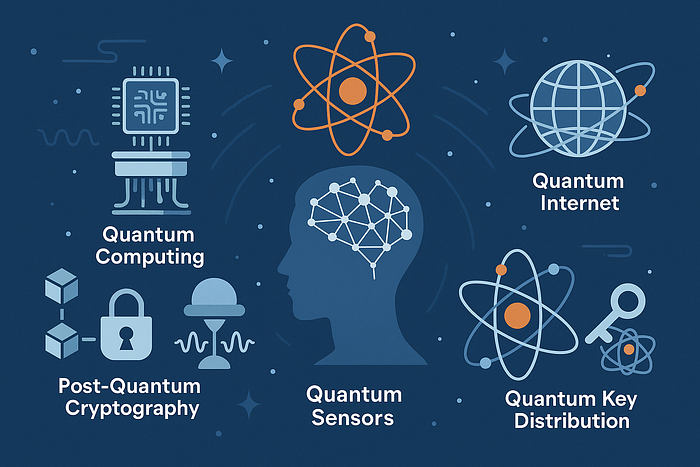
Quantum Technologies

Quantum Technologies

πŸ“’ I am thrilled to share insights from my comprehensive, AI assisted, research into the “Second Quantum Revolution.”

⚛️ Quantum technologies are poised to redefine our future. The research dives deep into five critical areas:

  1. πŸ”¬ Quantum Computing (QC): Unlocking unprecedented computational power.
  2. πŸ›‘️ Post-Quantum Cryptography (PQC): Securing our digital world against future threats.
  3. πŸ’‘ Quantum Sensors (QS): Revolutionizing measurement with extreme precision.
  4. 🌐 Quantum Internet (QI): Weaving a new fabric for communication.
  5. πŸ”‘ Quantum Key Distribution (QKD): Enabling provably secure information exchange.

It covers their current state, commercial viability, potential benefits, inherent risks, and crucial interdependencies. Understanding this evolving landscape is key for innovation and strategic planning.

⭐ Stay ahead of the curve in this transformative era!

Navigating the Quantum Revolution


News & References

Comments

Popular posts from this blog

Copilot Studio: Capabilities, Strategies, Scenarios

  πŸ’‘ Ready to Supercharge Your Team with AI? 🧠 A critical question for every leader: How do you transform the massive potential of AI into a practical, powerful, and cost-effective tool for your entire organization? πŸ€” This guide explores various nuances of the AI adoption: 1️⃣ The Innovation Opportunity: The drive to deploy generative AI is reshaping the modern workplace, offering a monumental leap in productivity and creativity. This is the moment to empower your teams. πŸš€ 2️⃣ The Strategic Blueprint: Unlocking this potential requires a clear strategy. Navigating the licensing models for powerful tools like Microsoft Copilot Studio is the key to maximizing value and avoiding unexpected costs. πŸ—Ί ️▶️ Our new interactive guide makes it simple. We break down the licensing paths, visualize the costs, and provide a clear, actionable roadmap for implementing a winning hybrid AI strategy. See how you can empower everyone, from citizen developers to pro-dev teams, to innovate safely and...

AI Agents as Trusted IoT/Software Defined Devices

  πŸ€– Your Newest Endpoint Isn’t a Laptop; It’s an AI Agent. Are You Ready to Secure It? Dive into the next frontier of cybersecurity. Autonomous AI agents are no longer just code; they are powerful actors in our digital ecosystems. Treating them as simple software leaves a massive security gap. Our latest report introduces a new paradigm: The AI Agent as a Software-Defined Device. Discover the essential framework for securing the agentic future: ➡️ The Agent-as-Device Model: Learn why abstracting agents as software-defined devices, similar to IoT endpoints, is the key to managing their complexity and risk. Secure the “hardware” (host), “software” (agent logic), and “network” (communications). ➡️ A Digital Passport for AI: Move beyond static API keys. Explore how Decentralized Identifiers (DIDs) and Verifiable Credentials (VCs) create a cryptographic root of trust, giving every agent a verifiable identity and provable permissions. ➡️ Defense-in-Depth for Agentic AI: Uncover the mult...

Skype for Business and VTC Interoperability

Skype for Business (SfB) has a very, very strong potential, I have written about it in my previous post . I can't think of any other platform that shows as much promise in terms of bridging personal and business communications as well as unifying different modes and mediums. And all of this may have started with a strategic acquisition of Skype by Microsoft in 2011. That said, the road ahead is not without challenges. For example, interoperability with other platforms. Making SfB work with existing Video TeleConferencing (VTC) systems, many of which represent significant capital investments in organizations' infrastructure, could be of a particular importance. After reading statements like Skype for Business is based on Session Initiation Protocol (SIP) standards and supports H.264 (MPEG-4 video coding standard) one can come to a quick conclusion that integration and/or interoperability with other VTC solutions is easy or nearly automatic. Unfortunately, the industry is not...