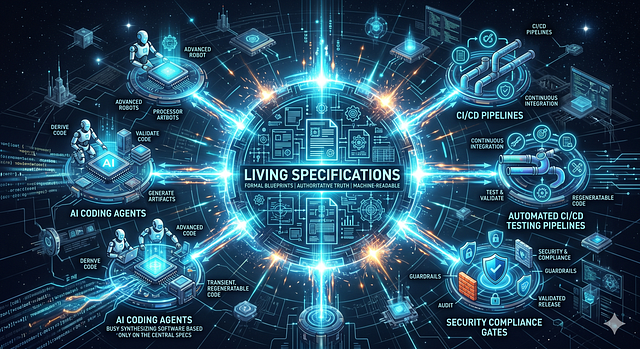
The Spec-Driven Future: Why "Vibe Coding" Is Failing the Enterprise

🥽 Dive into the tectonic shift defining the software engineering landscape, where the unstructured VibeCoding practice of the early AI era is evolving into a mature, enterprise-ready discipline. While conversational prompting works for rapid prototyping, it introduces hidden vulnerabilities, architectural drift, and compliance risks when scaled across complex enterprise systems. This reality requires organizations to evolve and adopt Spec-Driven Development (SDD), establishing formal, machine-readable specifications as the authoritative source of truth to safely govern autonomous AI execution.

💻 The modern enterprise defense against AI-generated technical debt is defined by an “intent-centric” strategy: establishing an executable control plane where human architects dictate the constraints, and AI agents execute the code. This methodology provides AI with explicit — like API contracts, security rules, and architectural decision records (ADRs) — preventing the inconsistencies of ad-hoc generation.

🔎 Discover the essential strategic framework for navigating this enterprise AI evolution, structured by three primary dynamics:

1️⃣ The Architectural Pivot: Managing the transition from ephemeral chat prompts to “Living Specifications” that operate as version-controlled code, strictly enforced by automated CI/CD conformance gates.

2️⃣ The Compliance Advantage: Prioritizing SDD for regulated enterprise environments (such as DIB/CMMC, Healthcare/HIPAA, and Finance/SOX), where auditable traceability and continuous compliance evidence are generated as a natural byproduct of the development cycle.

3️⃣ The Autonomous AI Augmentation: Deploying a multi-tiered “Minimum Viable Spec Backbone” — including organizational constitution files, API contracts, and acceptance criteria — to orchestrate multi-agent workflows safely and scale delivery across the enterprise.

📢 For enterprise architects, technology leaders, and platform engineers, this audio overview is your guide to the transformational forces reshaping AI-assisted software delivery. Prepare for the future of intent-centric engineering, today.

📺 The Spec-Driven Future: Why “Vibe Coding” Is Failing the Enterprise (podcast style, https://youtu.be/qxKvuu0X9Ws)

Comments

Post a Comment

Popular posts from this blog

Skype for Business and VTC Interoperability

Skype for Business (SfB) has a very, very strong potential, I have written about it in my previous post . I can't think of any other platform that shows as much promise in terms of bridging personal and business communications as well as unifying different modes and mediums. And all of this may have started with a strategic acquisition of Skype by Microsoft in 2011. That said, the road ahead is not without challenges. For example, interoperability with other platforms. Making SfB work with existing Video TeleConferencing (VTC) systems, many of which represent significant capital investments in organizations' infrastructure, could be of a particular importance. After reading statements like Skype for Business is based on Session Initiation Protocol (SIP) standards and supports H.264 (MPEG-4 video coding standard) one can come to a quick conclusion that integration and/or interoperability with other VTC solutions is easy or nearly automatic. Unfortunately, the industry is not...

WordPress displays weird characters

Sometimes after a database conversion (e.g. from MySQL to MariaDB) or due to encoding issues a situation might arise when WordPress is showing weird characters. A quick way of remedying the situation would involve examining the pages to discover a pattern (what characters are being substituted, in the example below the apostrophe was replaced by  ’ ) then running an queries against the database to reverse the effect. Here's a quick example (common tables that store content): UPDATE  wp_posts  SET  post_content =  REPLACE (post_content,  'Â' ,  '' )      UPDATE  wp_posts  SET  post_content =  REPLACE (post_content,  '’' ,  "'" )      UPDATE  wp_postmeta  SET  meta_value =  REPLACE (meta_value,  'Â' ,  '' )      UPDATE  wp_postmeta  SET  meta_value =  REPLACE (me...

IBM-Apple deal and its impact on Microsoft

IBM and Apple may seem to be the unlikeliest of partners at first, but the relationship truly is mutually beneficial – highlighting individual strengths (Apple – devices and ecosystem, IBM – enterprise capabilities and services) while avoiding competition (IBM is out of the device business, Apple is not particularly strong in the enterprise). This would not have been possible with IBM and Microsoft (both are competing in the enterprise market) or Apple and Microsoft (both are competing in mobile market). So, on the surface it appears to be a very important deal for the enterprise customers. It is also a deal that needs to be watched carefully as things develop (a somewhat similar arrangement between IBM and Palm did not generate much success). Read more on this subject here - Why the Apple-IBM deal matters How does this impact Microsoft? To a degree, though I don't think the impact is going to be very profound (something I can't say about other enterprise mobility players, ...